Spectera eliminates RF anxiety on the road with Foo Fighters
October 27, 2026

Industry veteran Monitor Engineer Ian Beveridge deploys Spectera to map stadium spaces with sonic clarity, preserving uncompromised stereo fields via Spectera’s bidirectional architecture
Vancouver, British Columbia, October 27, 2026 – Managing the live monitor world for the Foo Fighters requires a mix that can cut through a beautiful sonic wall of absolute chaos. With three full-throated, distorted guitars and a high-energy drum attack, creating intelligible space inside in-ear monitors (IEMs) is one of the most grueling assignments in professional live audio.
For 37 years, monitor engineer Ian Beveridge has been the steady hand at the console for Dave Grohl, with Beveridge going on tour with Nirvana to support their debut album in Europe. To eliminate baseline RF anxiety for an upcoming summer stadium tour, Beveridge and the technical crew deployed Sennheiser’s Spectera wideband bidirectional wireless system, transforming their workflow and unlocking unprecedented spatial clarity.
“Traveling all over the world, swapping out narrowband systems for different geographical areas — it becomes a royal pain in the neck,” Beveridge says. “When Spectera became available, I pulled the trigger without even hearing it. I’d seen enough evidence to suggest it was going to be great, and it proved to be more than great. It’s been utterly rock solid.”
Beveridge’s journey to the mixing board is a classic tale of true rock-and-roll grit. Much to his father’s dismay, he left a predictable future on a civil engineering path at university and answered a local newspaper ad for an unpaid studio position in the basement of a video store. That leap led to live sound when a booking agent asked him to handle an incoming American band’s European van tour, where the rest was history.
“He sent me Bleach, the first Nirvana record, on vinyl,” Beveridge recalls. “It blew the foam off my cappuccino. I flew to London, met the band, and hit the road. When Nirvana ended, Dave called me up and said, ‘Hey, I'm going to start a band, you want to come work for me?’ I started with Dave when I was 26 years old, and this year I’ll be 63. I think I’ve done a decent spell.”
While Beveridge has embraced the digital revolution of Spectera for monitor distribution, his vocal chain choice remains defiantly old-school, anchored by the Sennheiser MD 431 dynamic microphone to protect more than just the band’s sonic signature.
“One of our previous front-of-house engineers wanted to switch to a heavier, boutique brass mic,” Beveridge recalls. “I told him, ‘Sure, we can change it. But when the boss is running across that stage doing 20 miles an hour, slams into a heavy brass mic, and takes out his front teeth, are you going to be the one to explain that to him?’ He said, ‘Let’s just leave the 431 up there.’ As long as I’m the monitor engineer, that will always be the microphone for this band.”
While the vocal microphones address the requirements at the front end, the monitor mix presents another challenge: maintaining a precise and stable stereo image across the band’s dense arrangements. Conventional analogue FM stereo IEM systems rely on multiplexing to encode the left and right channels, and stereo separation can deteriorate as RF conditions become less favorable. With Spectera’s digital IEM transmission, the team is able to maintain clear left-right separation and a stable stereo image throughout the performance.
“With the Foo Fighters being a three-guitar band, the only way to create space so you can actually hear everything is by panning them,” explains Beveridge. “If that stereo width collapses, your levels shift, everything steps on each other, and all that mixing just goes to hell. Spectera actually delivers that true separation.”
Sennheiser artist relations manager Tim Moore echoes this advantage. “With Spectera’s discrete separation, you can place one guitar far left, one far right, and one dead center. You don’t have to engage in a volume fight to create definition; the instruments just appear clearly within the soundstage, which drastically reduces ear fatigue.”
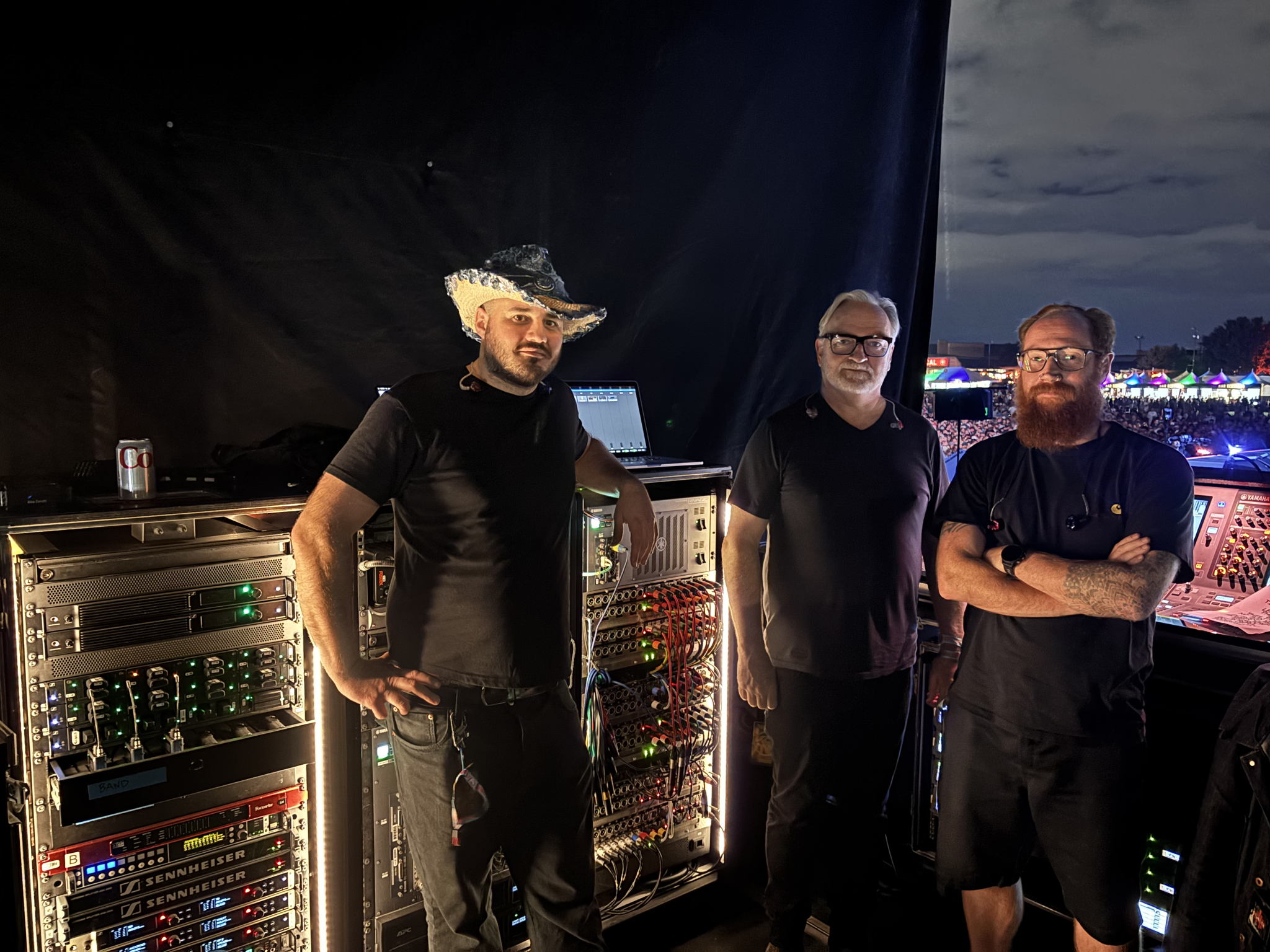
This architecture faced its ultimate trial-by-fire debut during a live television broadcast for SNL UK in London — a notoriously brutal RF environment.
“The first time we turned it on, the meters were actually showing interference at the base station,” Beveridge laughs. “But I just grabbed my bodypack, put my ears in, and walked through corridors, through thick brick walls, and all the way out past the production trucks parked outside. The audio was completely rock solid. From that point on, I stopped worrying.”
Beyond transmission, Spectera’s bidirectional control managed via WebUI dismantles the daily logistics of frequency coordination. Walking a single pack maps the entire venue instantly. Furthermore, Spectera enables Beveridge to assign different audio link modes to individual bodypacks depending on the application.
“You can actually shape and contour the resources of the system to fit the gig,” Beveridge says. “For the lead singer, you allocate the absolute lowest latency possible. If it’s a tech crew member or management, latency doesn’t matter as much. And if a guest musician suddenly walks up right as the band is hitting the stage, we have so much over-spec’d capacity that I can instantly route a guest mix and hand them a pack without a single worry.”
The system’s bidirectional connectivity also eliminates mid-show RF interference. On a legacy narrowband system, moving a large multi-performer configuration away from a compromised frequency block requires individually reprogramming and manually IR-syncing every unit.
“We’ve actually had to shift frequencies as the band was walking out onto the stage,” Beveridge reveals. “With Spectera, you change it in the software, and without anyone touching a single bodypack, they automatically jump to the new TV channel together in about 20 seconds. It completely saves the show.”
This consolidation has profoundly redefined Monitor World’s physical footprint. Heavy, towering five-foot rolling racks filled with legacy transmitters and combiners have completely vanished. “Our radio world rack went from a massive five-foot cabinet stuffed with gear down to a 2U space,” smiles Beveridge. “It’s just two base stations and a laptop. It takes up absolutely no room, and yet it manages our entire wireless universe.”
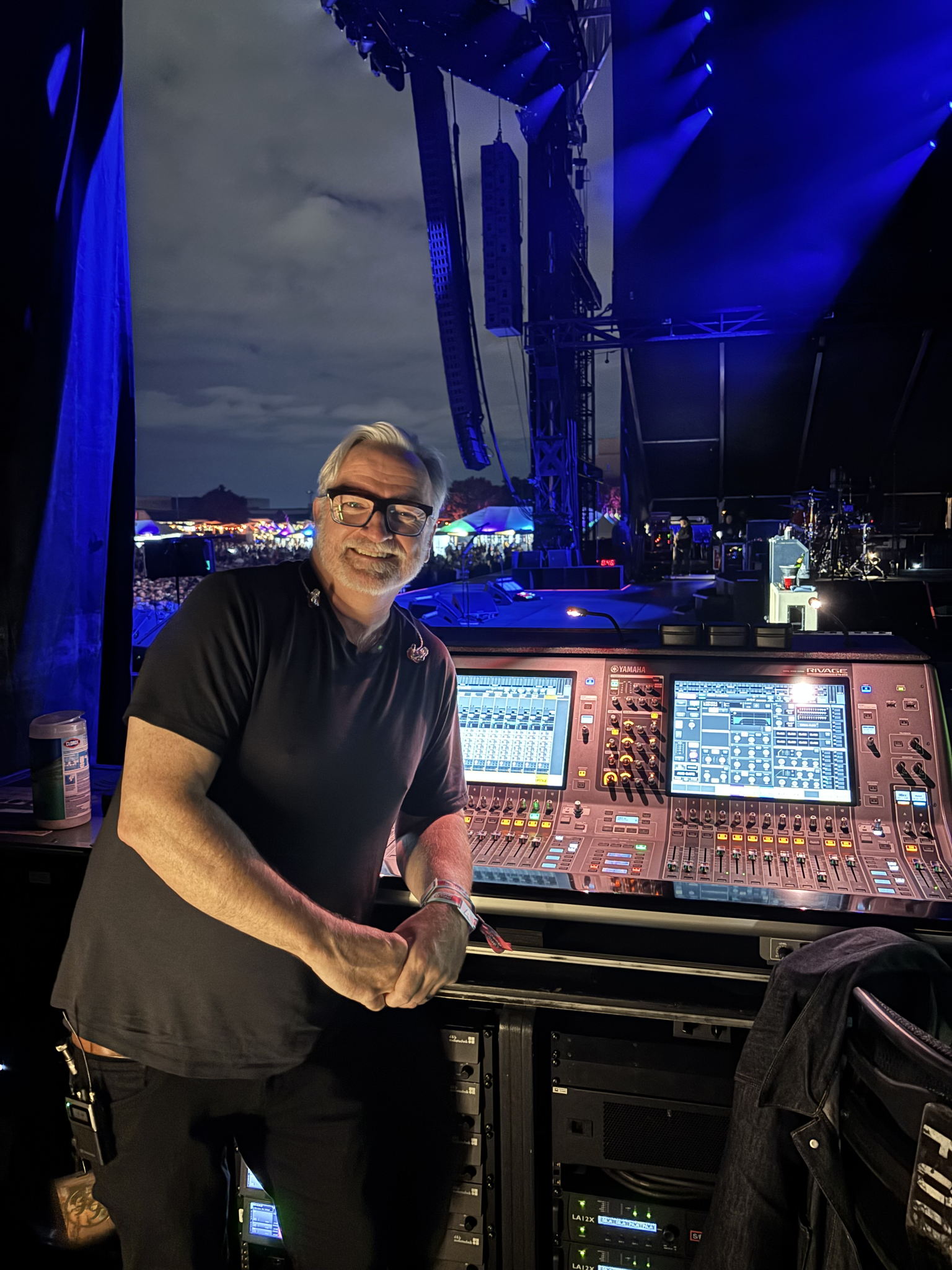
Ultimately, the triumph of Spectera lies in its ability to make complex digital engineering feel completely invisible when the house lights drop, allowing decades of raw rock-and-roll intuition to take center stage. “I’m at a point now where I don’t even think about the RF,” Beveridge reflects, looking out across the empty arena before soundcheck. “I don’t have to show up at eight in the morning to fight the airwaves anymore. I come in at four o’clock, I put my white gloves on, I listen to one pack, and I just mix music.”
(Ends)
The high-resolution images accompanying this media release can be downloaded here.
Foo Fighters_Spectera_PR.docx
DOCX - 6.0 Mb
Foo Fighters_Spectera_PR.pdf
PDF - 6.5 Mb

Jacqueline Gusmag
Global PR & Influencer Manager, Sennheiser electronic SE & Co. KG


