Louis Philippson and ensemble on tour

“Classical Music for Everyone” tour with Neumann MCM microphones and Sennheiser Spectera
Wedemark, February 2026 – Louis Philippson, a classical pianist and an exceptionally gifted musician with perfect pitch, first drew attention to himself when he was just seven years old with a YouTube video of his performance during a talent competition. Born in 2003, Philippson, who has synaesthesia, has since become a social media phenomenon with more than 1.3 million followers and is seen as one of the most successful classical music influencers. With his charm, wit and virtuosity, he delights millions of fans, helping to inspire a passion for piano playing (not only) among the Gen Z community.
No compromises: signal transmission with Spectera in “Raw Low Latency” mode
On Philippson’s current tour “Classical Music for Everyone 2025/26”, Neumann Miniature Clip Mic MCM systems reproduce the performance of the artist and his ensemble in incredible detail, picking up even the finest sound nuances. The microphone signals are transmitted wirelessly via the Sennheiser Spectera wideband ecosystem – the ‘dream team’ for audio signal processing that meets the highest audiophile standards.
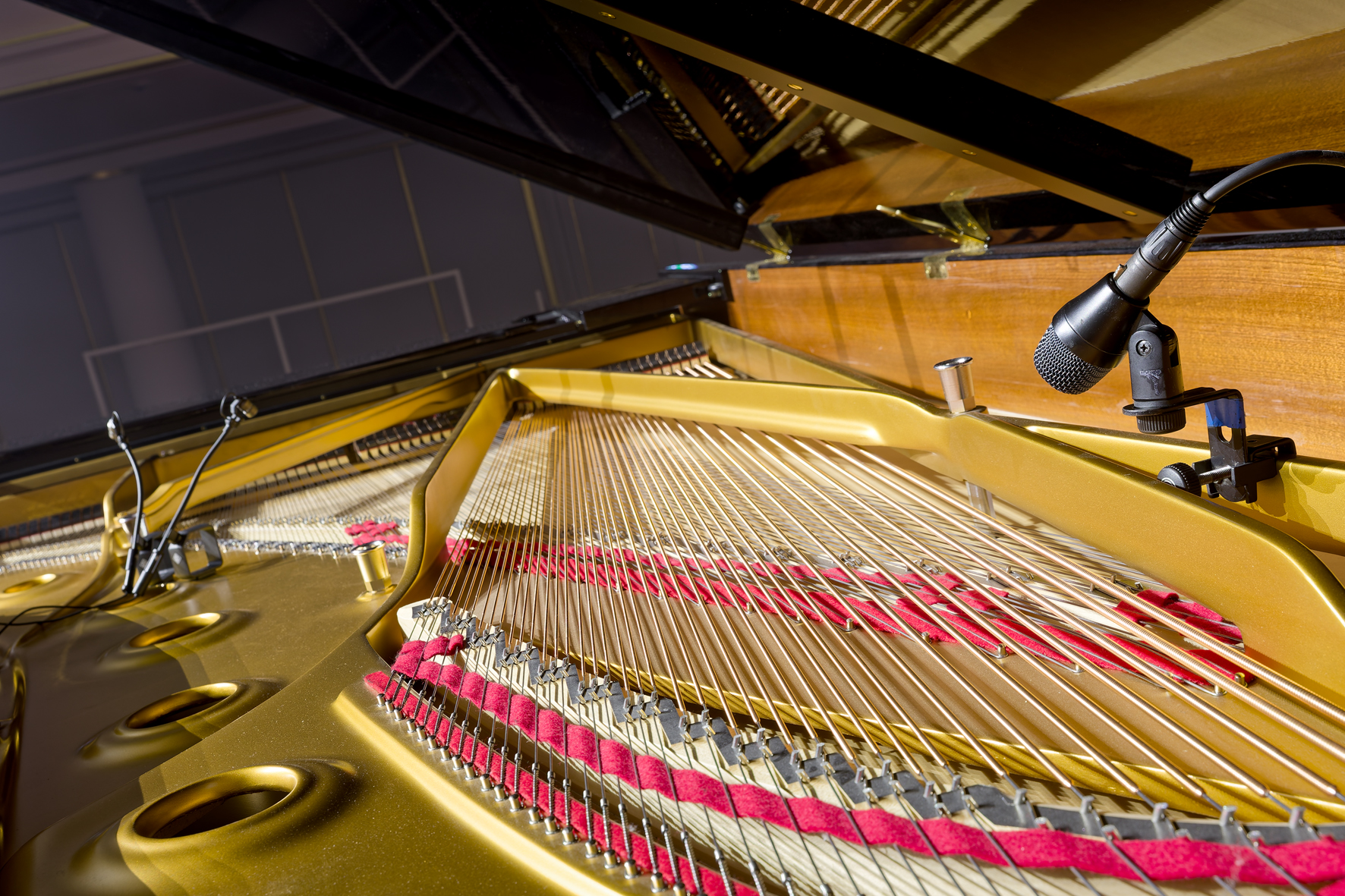
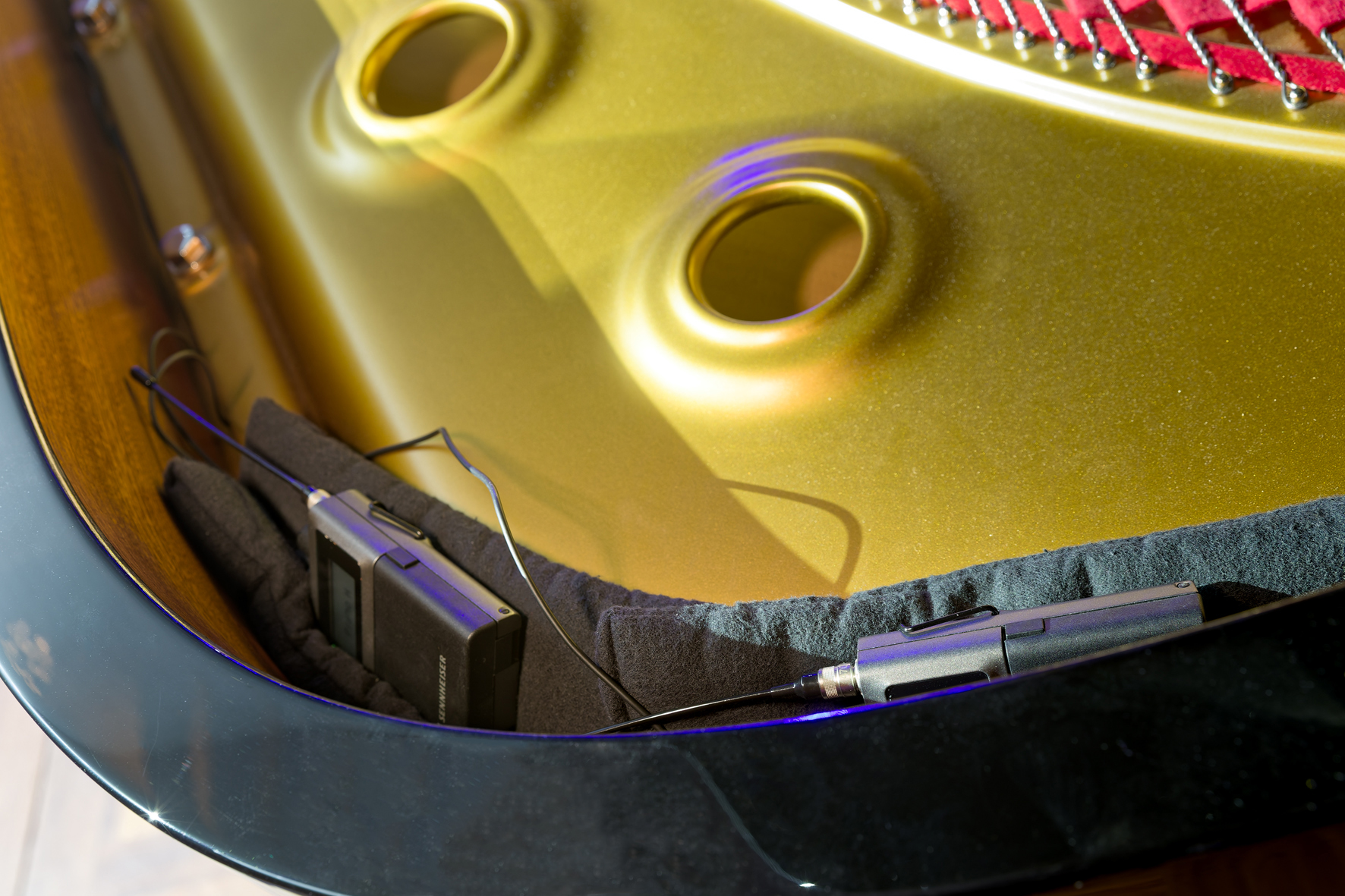
Six Spectera SEK bodypacks are used to transmit the microphone signals on Louis Philippson’s tour: FoH engineer Thorsten Seeliger places two packs on padded mats in the grand piano, and a further four are used by the “Berlin Chamber Collective” (first and second violins, viola, cello), who accompany the pianist. For wireless transmission to the Spectera Base Station, Seeliger has selected the “Raw Low Latency” audio mode, which ensures the best possible PCM audio quality with a bit depth of 24 bits and a sampling rate of 96 kHz, with latency at just 1 millisecond. The Base Station uses an 8 MHz wide UHF channel. Seeliger keeps the second available 8 MHz channel free as part of his emergency back-up concept.
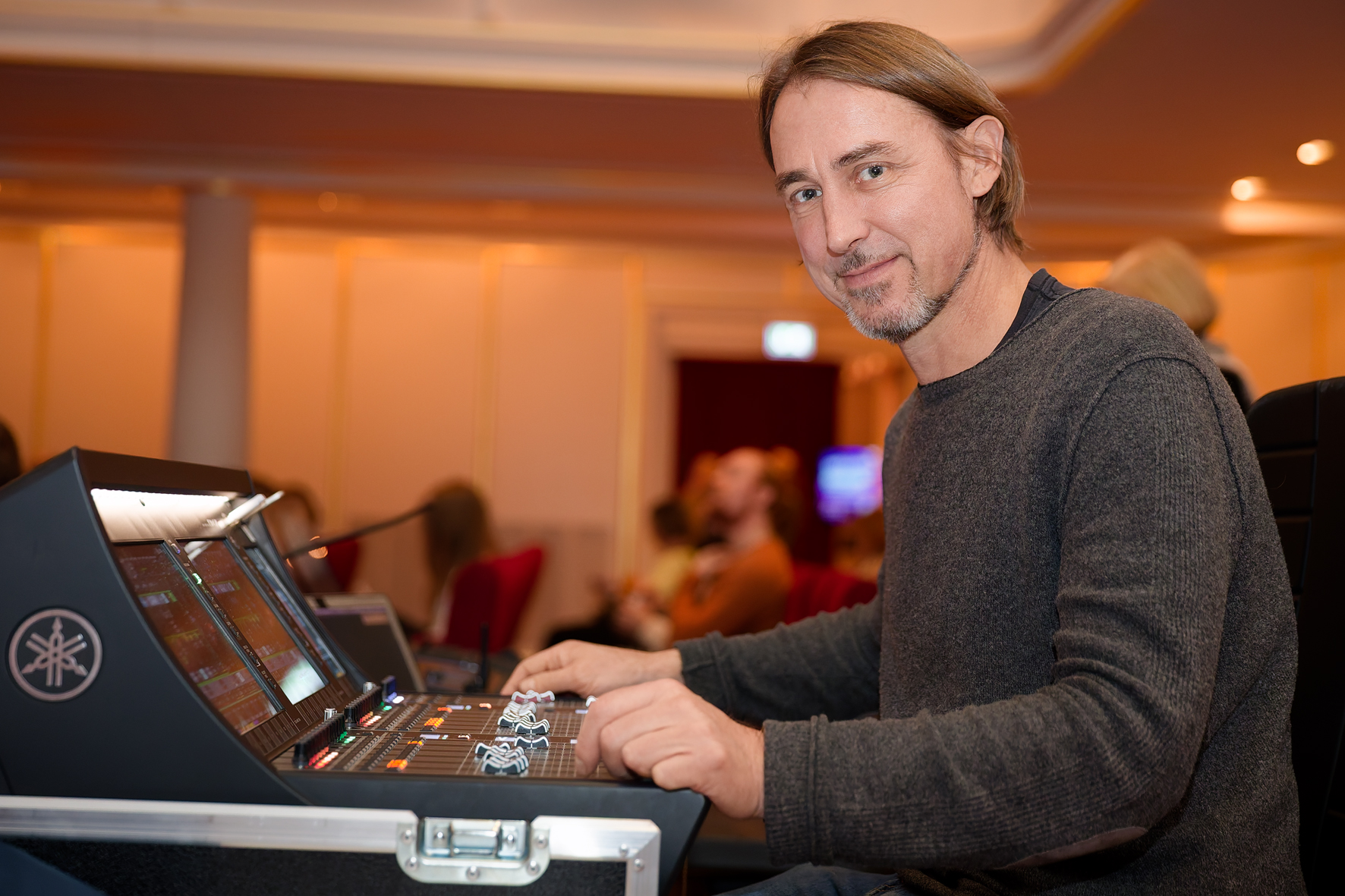
Two DAD antennas are connected to the Spectera Base Station using network cables. They are supplied with power by PoE and are placed on stands on the right and left of the stage. The Base Station is connected to the digital mixing console via Dante. Sennheiser Spectera WebUI running on a laptop at the FoH console provides a perfect overview and extensive remote control options. The BA 70 lithium-ion battery packs for the SEK beltpacks are recharged in a Sennheiser L 6000 charging station.
Neumann MCM 114 sets for the grand piano, violins, viola and cello
The modular Neumann Miniature Clip Mic MCM system was developed for close miking acoustic instruments on stage and in the recording studio. Special mounting clips (MC 1 to MC 9) and three goosenecks with different lengths ensure gentle and low-vibration mounting on all kinds of instruments – from strings and brass instruments to pianos and drums.
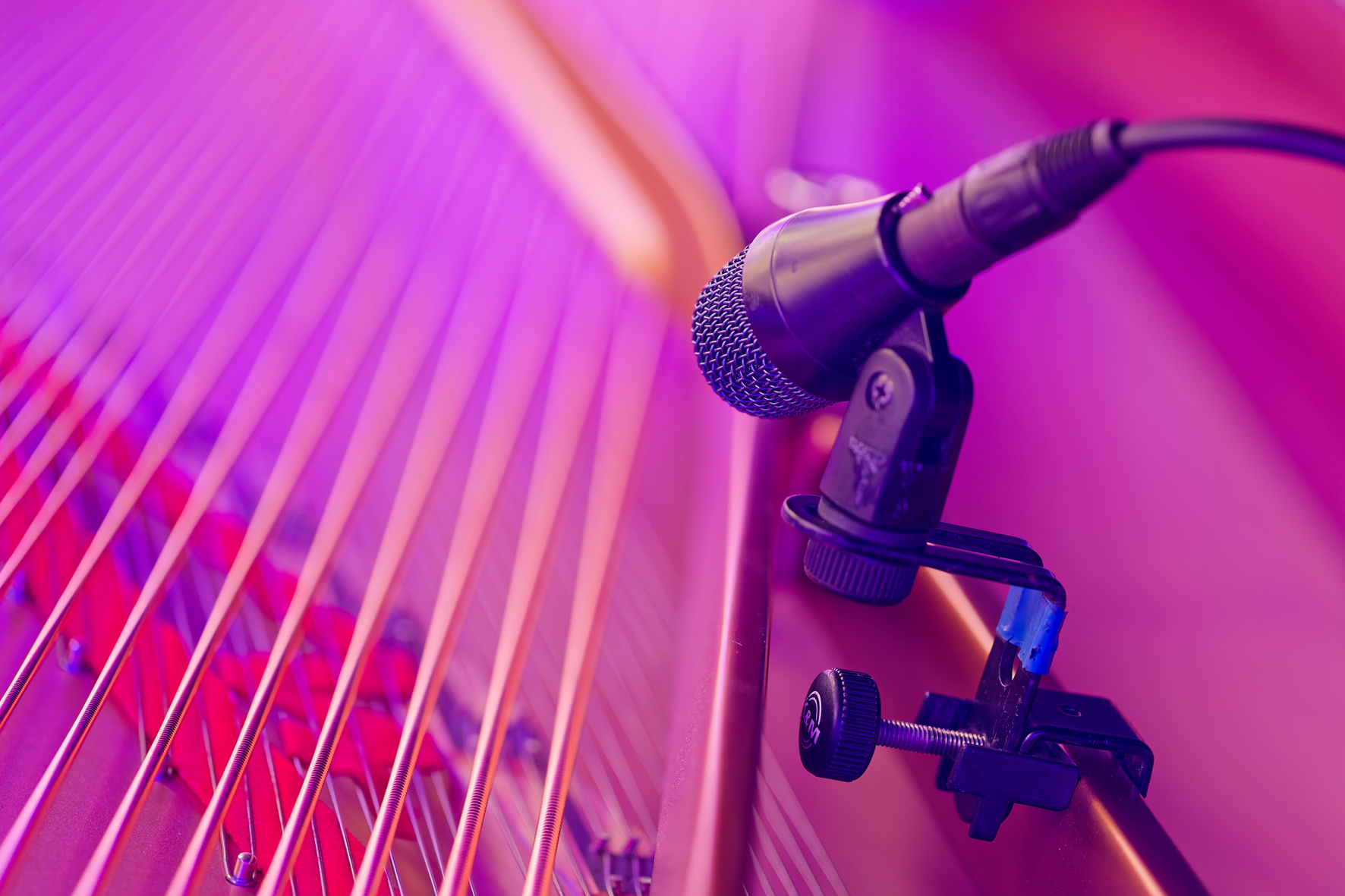
For miking the grand piano, Seeliger employs the Neumann MCM 114 Stereo Set Piano, using Neumann MC 8 Magnetic Piano Clips to direct the capsules at the tenor and treble strings in an AB arrangement. The Neumann microphones are supplemented by a dynamic Sennheiser evolution e 904 instrument microphone mounted at the tip of the piano above the bass strings.
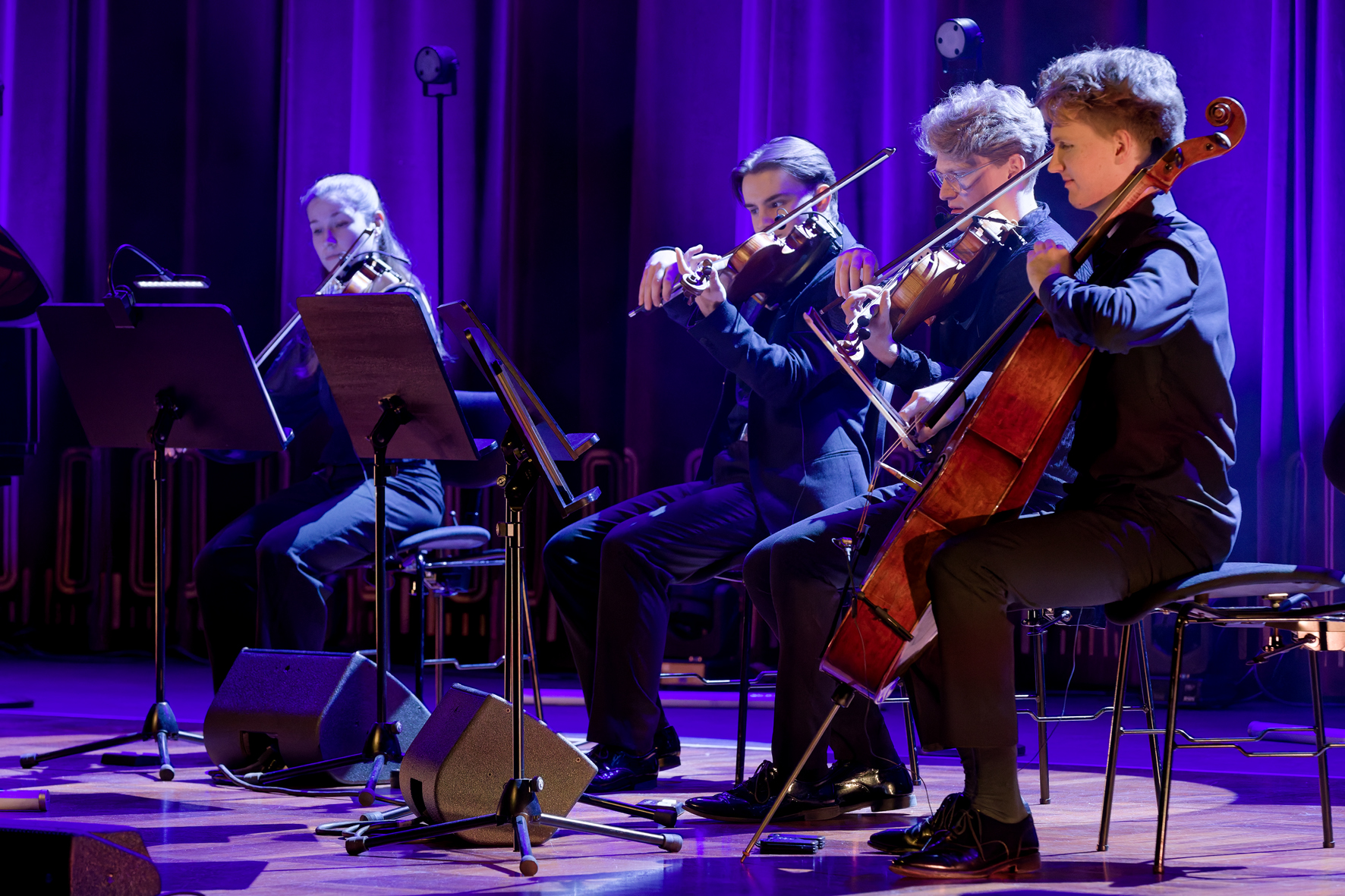
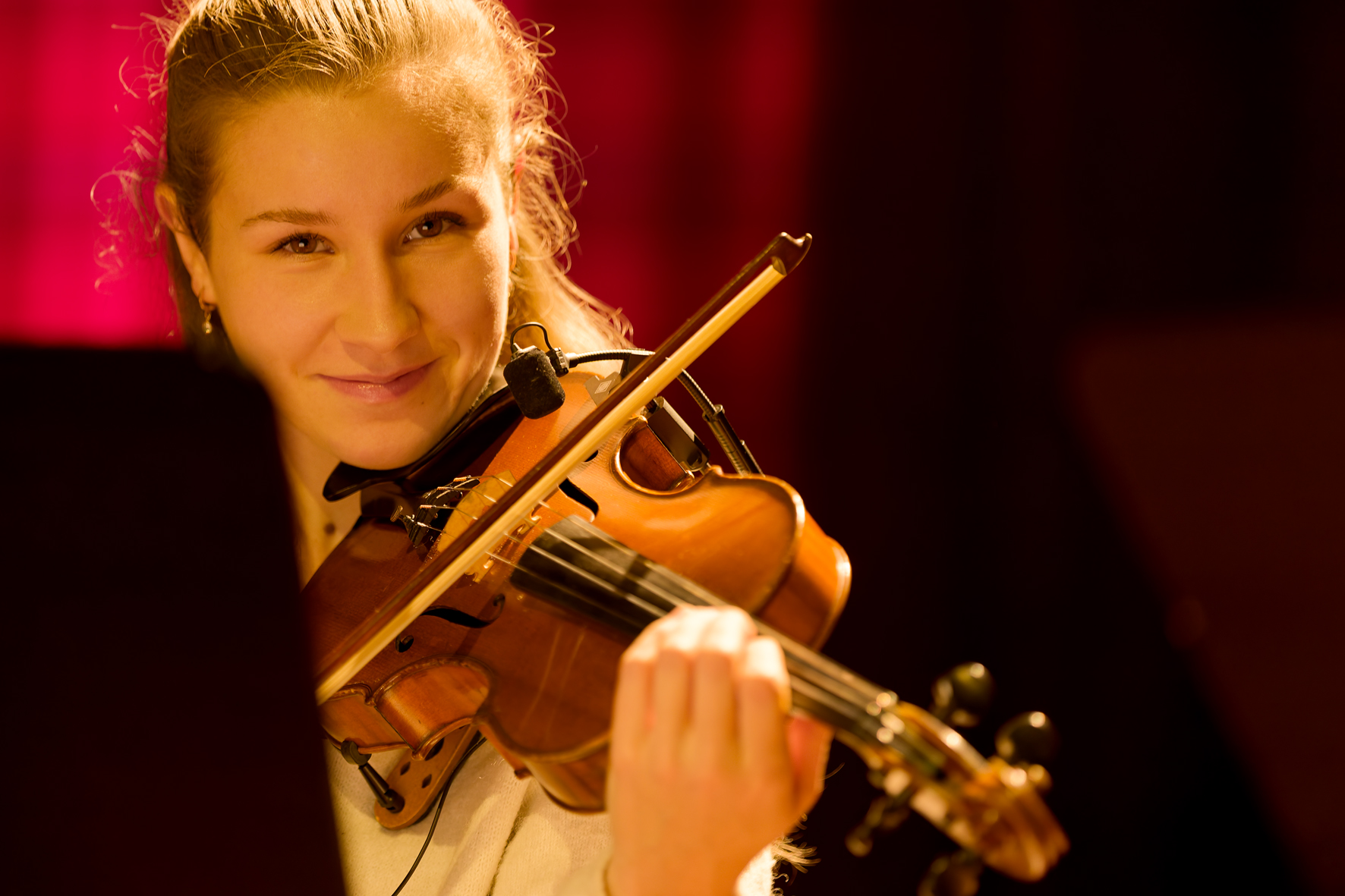
The first and second violins and the viola each use a Neumann MCM 114 Set High Strings (MC 1), while the cello is miked with a Neumann MCM 114 Set Cello (MC 2). The Miniature Clip Mic system elevates the electret principle to a new sound standard, ensuring impressively natural reproduction of the bass and tenor ranges and transparent trebles.
To address the audience, Philippson relies on a Sennheiser SKM 500 G4-S handheld transmitter with an MMK 965-1 capsule and an EM 300-500 G4 True Diversity receiver. A further G4 handheld transmitter with an MMD 935-1 capsule is used by Seeliger as a talkback microphone. One of the responsibilities of the highly experienced audio professional at NORDLITE Event Solutions GmbH is distributing Spectera. He has been accompanying Louis Philippson since the autumn of 2024, initially as his tour manager and now, during the current “Classical Music for Everyone” tour, in his dual role as chief sound engineer and tour manager.
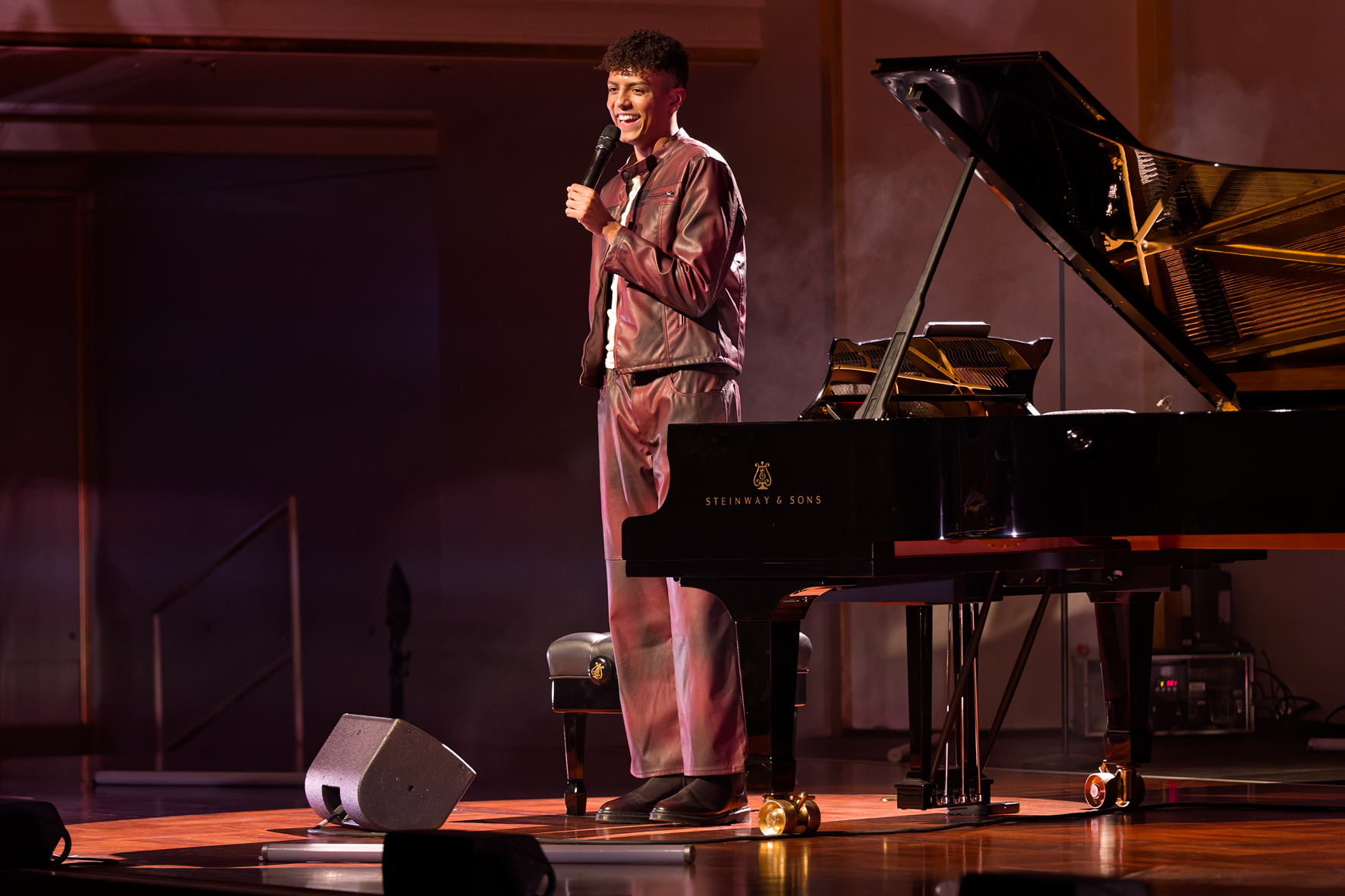
“This combined use of Neumann MCM microphones and the Sennheiser Spectera wideband wireless system on the ‘Classical Music for Everyone’ tour is something new for me, although I’ve owned the MCM sets for quite some time now and I use them regularly,” says Seeliger. “The SEK bodypacks are bidirectional, which means that they can transmit mic/line signals and receive IEM signals simultaneously. However, conventional wedges are employed as monitors on Louis Philippson’s tour, as the young ensemble is not yet experienced in the use of in-ear systems. I’ve found that many classically trained musicians tend to view in-ear monitoring with some scepticism at first, as they are accustomed to purely acoustic listening environments. I can fully understand that the ensemble didn’t want to start using IEMs in concerts straight away without having had time to get used to it.”
The use of wedges on stage was the reason why Thorsten Seeliger selected KK 14 capsules with a cardioid pick-up pattern rather than the omnidirectional Neumann KK 13 model. By doing so, he wanted to avoid crosstalk between the microphones and prevent potential feedback. The ensemble had no objections to attaching the MCM clips to their instruments, and Louis Philippson also had no concerns about having microphones and bodypack transmitters placed in his piano.
“During most of the concert, I only make subtle use of mixing the signal from the Sennheiser e 904 on the bass strings of the piano with the two Neumann MCM microphones,” Seeliger reveals. “However, the programme also includes a piece by AC/DC, and for this I can use the e 904 to provide the powerful low-end ‘punch’ that is needed.” As far as the overall sound is concerned, this somewhat unusual combination of three microphones delivered exceptionally good results during the concert.
To make the sound as clean and transparent as possible, Seeliger deliberately avoided using miking set-ups that are commonly favoured in classical music contexts, such as small- or large-diaphragm microphones arranged at some distance from the instruments. “The MCM sets provide a very rounded and soft sound even with close miking. And not only that, having a tidy, uncluttered stage is very important for us,” he commented. “It’s really fantastic that we no longer need to lay cables on the stage and still don’t have to make any compromises when it comes to sound quality.”
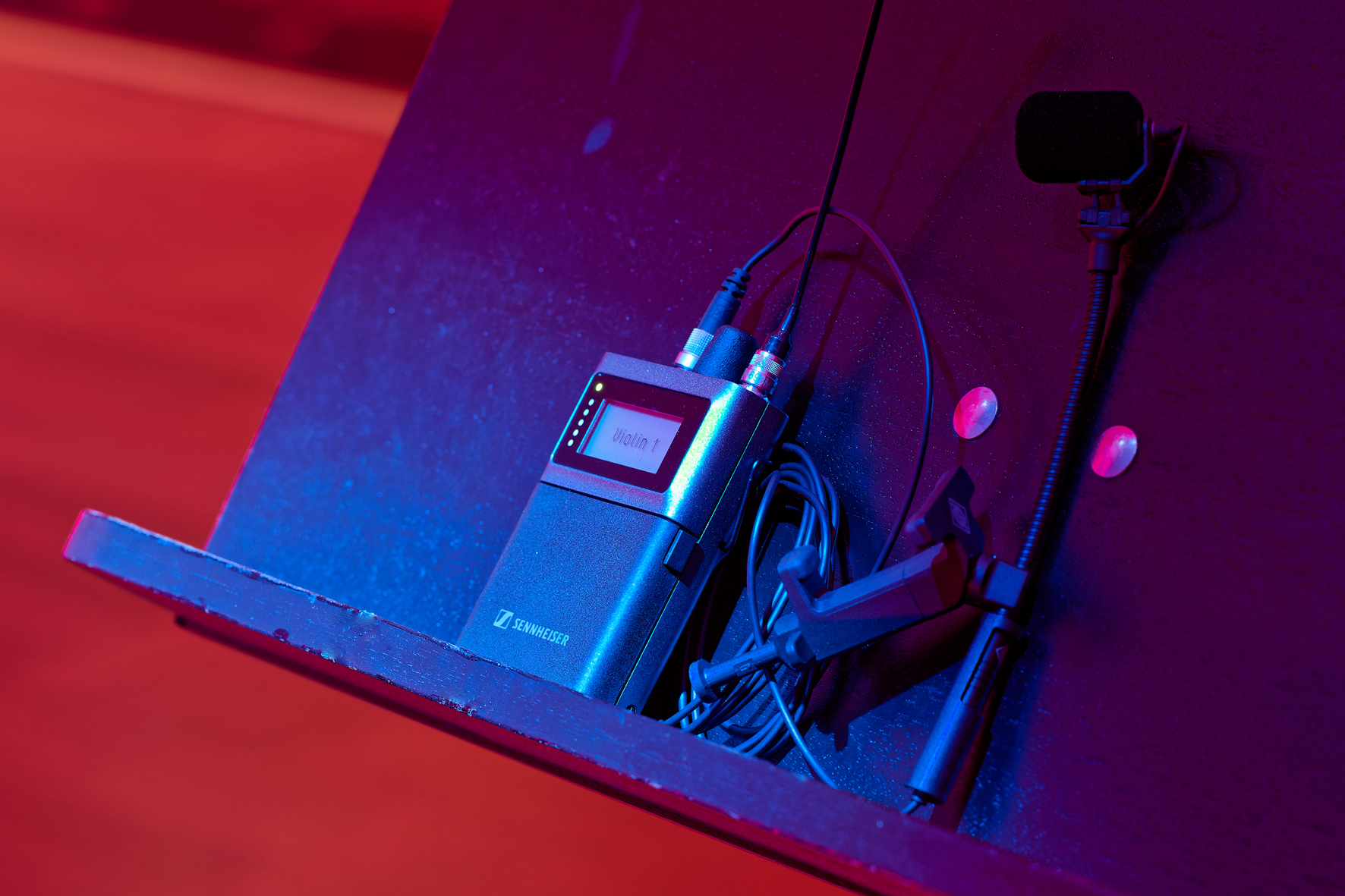
Frequency management, which often used to be a complex affair, is now no problem at all, much to Seeliger’s delight: “It’s become really easy. I carry out a scan once at the venue, select a free area, enter the values and, in a workflow that takes about 15 seconds, I’m ‘set and done’. The bodypacks are also automatically set to the correct frequency range without any input from me. This means that the whole system is ready to start much quicker than before. And I no longer have to bother with putting tape on the bodypacks to mark the user’s name.”
Another benefit of Spectera that helps to ensure a faster set-up is its small space requirements: the Base Station takes up only one RU when it is installed in a 19” rack. Depending on the audio mode, it controls up to 64 audio links (32 inputs and 32 outputs) and uses up to two independent RF wideband channels instead of a large number of narrowband RF carriers.
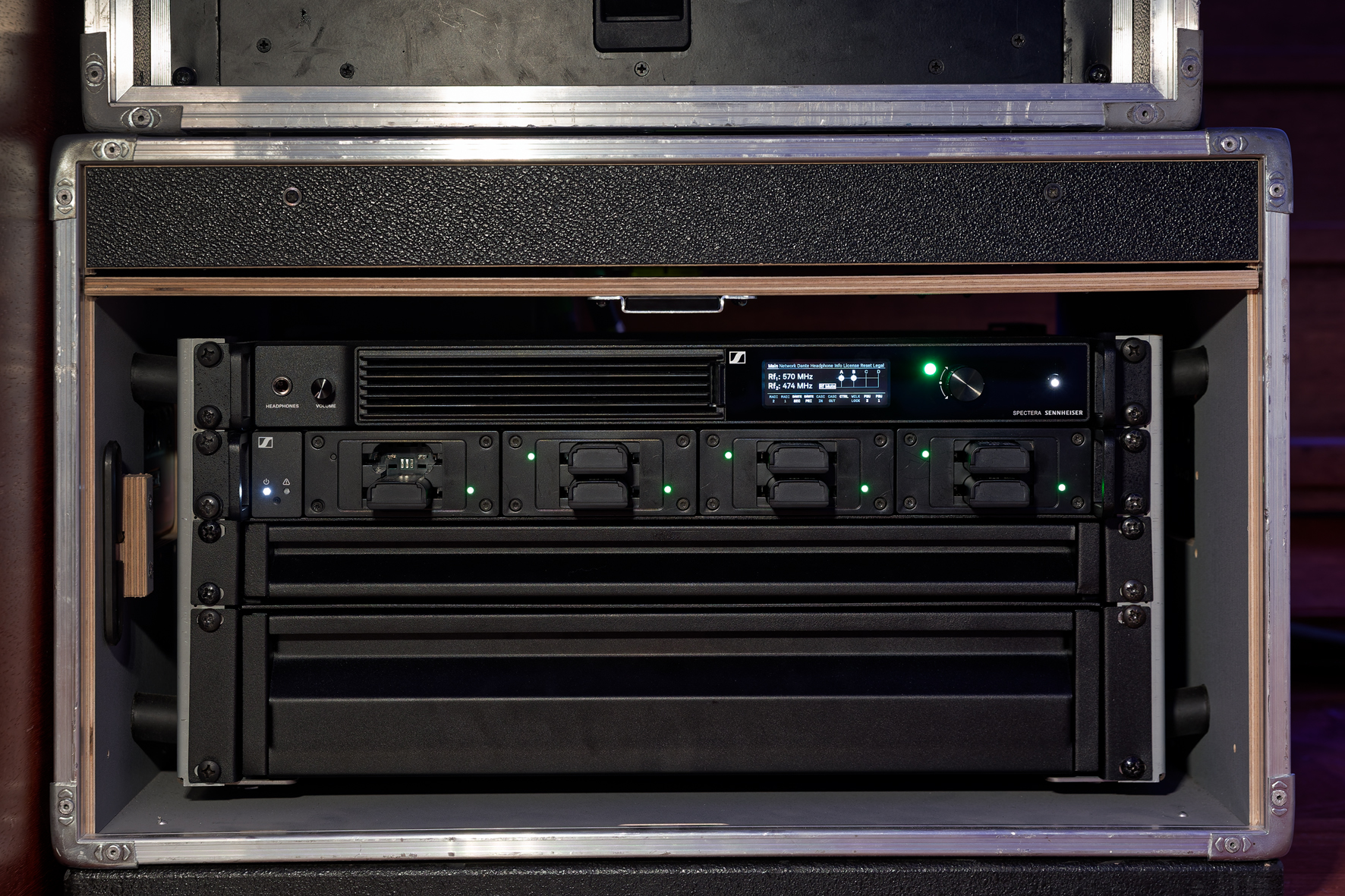
Spectera + MCM = a premium audiophile package
Thorsten Seeliger describes this combination of Neumann Miniature Clip Mic MCM systems and the Sennheiser Spectera wideband ecosystem as a “premium audiophile package” – but one that does not demand a premium price. “When used together, the components deliver outstanding sound quality which, in my opinion, similar products from other providers cannot get close to achieving. The sound is excellent without any major adjustments to the channel EQs, and the price/performance ratio is really attractive.”
“When it comes to providing the sound for my concerts, I have 100 percent confidence in Thorsten Seeliger,“ says Philippson. “Although I always want to know and learn as much as I can, my knowledge of audio technology definitely has a lot of room for improvement. I’m currently making my first attempts at recording my piano at home. At the moment, I’m still using my smartphone or the built-in microphone on my digital camera, which is certainly not an ideal solution, although it’s good enough for short videos on social media. But for real concerts, of course, there’s nothing more important than sound quality, and I am really pleased that we are using products from renowned companies such as Neumann and Sennheiser on my tour. I’m still a newbie as far as sound engineering is concerned, but I am, of course, familiar with these famous names.”
Jörg Langel (Business Development Manager - Touring & Rental Professional Audio), who is Thorsten Seeliger’s main contact partner at Sennheiser, comments: “The new Neumann MCM series is able to unleash its full sound potential when used together with the innovative Sennheiser Spectera ecosystem. The wireless transmission of uncompressed PCM audio signals with a word length of 24 bits and a sampling rate of 96 kHz ensures exceptionally precise and natural signal reproduction that sets standards in every respect.”
Classical, but modern…
On their “Classical Music for Everyone” tour in 2025, Louis Philippson and his ensemble already celebrated sold-out venues and delighted their audiences, who, by the usual standards of classical music concerts, were surprisingly young and were clearly having a great time in a relaxed atmosphere. Due to this overwhelming success, the tour is scheduled to continue from the end of February 2026. In his two-hour concert, Philippson combines new arrangements of favourite works by Beethoven, Chopin and Brahms, along with popular film and television soundtracks, including compositions by Hans Zimmer. And the repertoire even includes the AI-generated piece ‘Beethoven Virus’, which is generally considered to be unplayable.
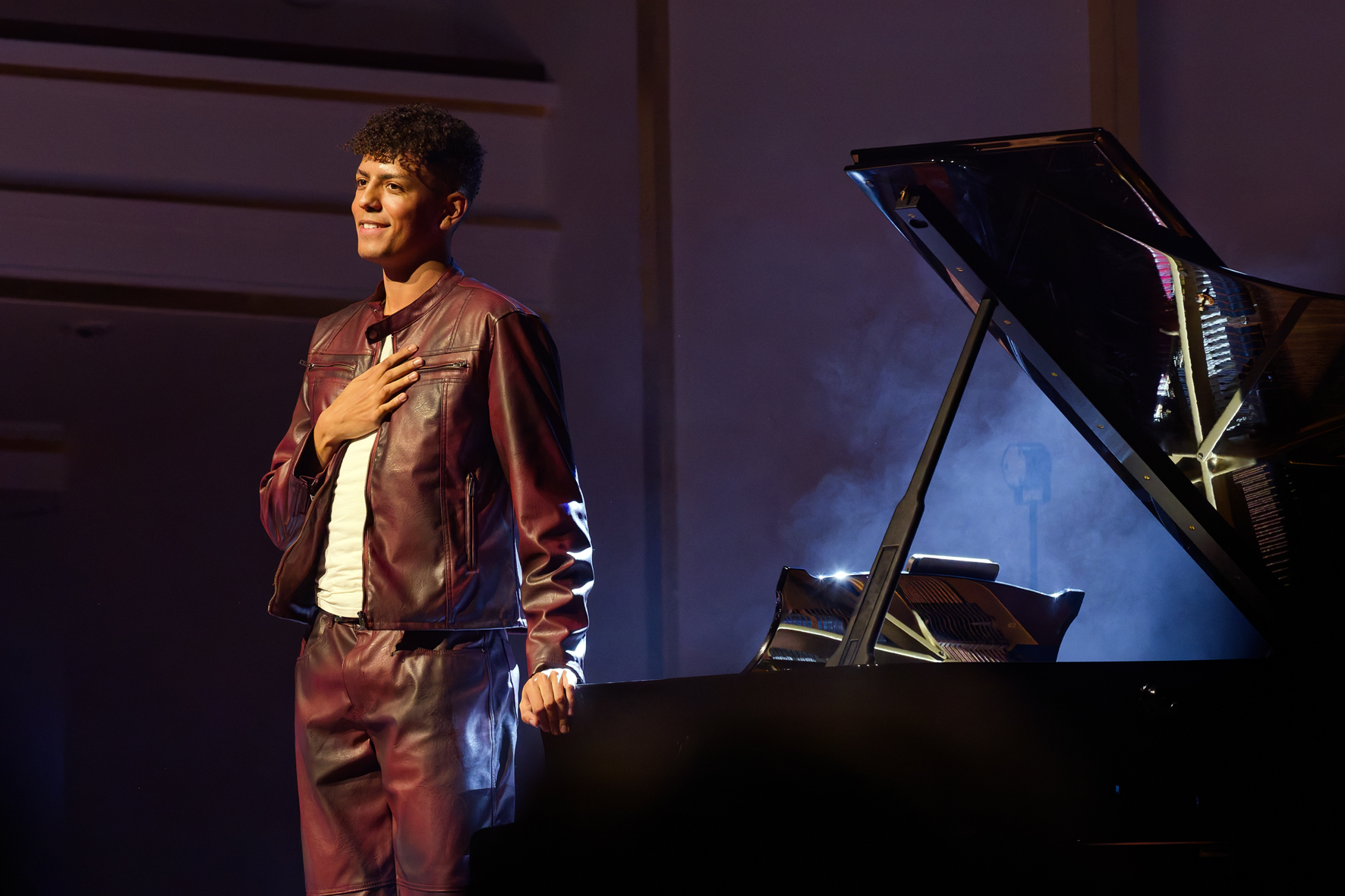
The sound quality on the “Classical Music for Everyone” tour, achieved with the Neumann Miniature Clip Mic MCM system and Sennheiser’s groundbreaking Spectera wideband system, is an acoustic delight that impresses even the most discerning of listeners. Rarely has electroacoustically amplified classical music sounded so harmonious – and so modern – as it does when it is played by Louis Philippson.
About Louis Philippson, a Gen Z piano sensation
Louis Philippson (www.instagram.com/louisphilippson/) is known for effortlessly combining established classical traditions with contemporary musical trends. His progression from student life at the Robert Schumann Conservatory in Düsseldorf into the digital spotlight as an internet star seemed to happen quite casually, almost on a whim. It was during the Covid pandemic that Philippson had the idea of presenting his exceptional piano skills on his TikTok channel, embellished with witty comments, surprising interpretations and his typical tongue-in-cheek playfulness. For example, based on a popular internet meme (“Hands according to composers”), he played Chopin using a whisk and then Beethoven with a hammer (well, almost …). In the meantime, his online presence has become a contemporary showcase for a music genre that is otherwise generally ignored by Gen Z, and is seen by many as elitist and old-fashioned. But Philippson proves that classical music can be extremely lively, that it can be surprising and even provocative, which is very appealing particularly to a younger audience.
Musically, Philippson is both a crossover artist and a mediator. His debut album “Exposition”, which was released in 2025 and won a prestigious OPUS KLASSIK award in the category “Classic without Limits”, breaks with conventional expectations of the genre. He combines his own compositions with neoclassical music and new arrangements of popular works, which are always characterised by his own personal touch. As he says himself, “Exposition“ is a Louis Philippson album: an emotional appeal without purist doctrines and with a refusal to be pigeonholed.
And Philippson also has many other creative activities away from the piano. Alongside his career as a pianist, he is studying international business, presents programmes on TV channels Toggo and ZDF and can be seen on stage at major concert halls and even arenas, for example at the “Night of the Proms” series in 2024. He says that, for him, time management is not a problem and multitasking is like an elixir that provides him with fresh energy.
For Philippson, live performances seem to be both a space for experimentation and a meeting place, and his success proves him right. During his concerts, the young performer shows how modern and how accessible classical music can sound – engaging, lively, witty, profound and always performed with virtuosity. His arrangements of pop hits, his viral piano videos and his own compositions make Louis Philippson perhaps one of the most exciting voices in a new generation of classically trained musicians.
(Ends)
The high-resolution images (tiff) accompanying this media release, plus many additional images, can be downloaded here.
Louis Philippson_Spectera_e.docx
DOCX - 3.4 Mb
Louis Philippson_Spectera_e.pdf
PDF - 1.0 Mb

Stephanie Schmidt
Regional PR & Influencer Manager DACH/UK/Nordics, Sennheiser electronic SE & Co. KG


